
By Dr. Edelia J. Carthan,
Contributing Writer,
Mississippi is making national headlines again, this time for an idea that could put custom Nike sneakers on the feet of high school valedictorians across America.
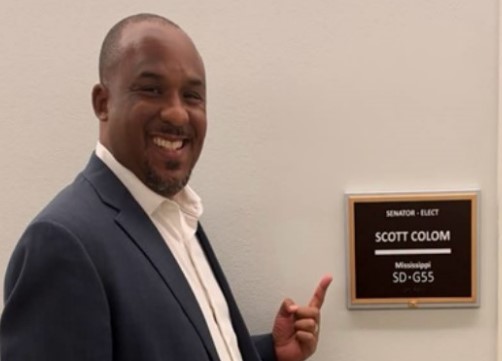
U.S. Senator-elect Scott Colom proposed that Nike recognize Mississippi’s top graduating students with specially designed Air Force 1 sneakers. The company liked the idea so much that it announced plans to expand the initiative nationwide for the 2026–2027 school year.
“The athlete mindset makes things possible, including this idea,” Nike wrote on X. “For this year, 2026/2027 high school valedictorians from across the U.S., let’s go! Stay tuned for more info.”
Colom welcomed the announcement but had another suggestion. He wants Nike to consider incorporating Hiram Rhodes Revels, the first Black United States senator, into the design.
“I’m so proud of @Nike for stepping up to motivate students across the country in this historic moment,” Colom wrote on X. “This is the #justdoit mentality that makes your company great. Please consider honoring Hiram Revels in the design.”
The historical connection is significant.
In 1870, Revels made history when the Mississippi Legislature elected him to the United States Senate during Reconstruction. He became the first Black person to serve in Congress, just five years after the Civil War ended.
His election was no small accomplishment. Black Mississippians were beginning to exercise political power in a state where slavery had been central to the economy. Despite opposition from white lawmakers who challenged his eligibility, Revels took his Senate seat on February 25, 1870.
Following his Senate service, Revels became the first president of Alcorn University, now Alcorn State University, which opened in 1871 to educate formerly enslaved people and their descendants.
More than 150 years later, another Black Mississippian elected to the U.S. Senate is calling attention to Revels while promoting educational achievement.
There is something particularly fitting about that connection.
Mississippi is frequently portrayed as a state that lags behind the rest of the nation. Its struggles with poverty, education and racial inequality have shaped much of its national reputation. What often gets overlooked is how frequently Mississippi has been at the forefront of changes that transformed America.
Mississippi gave the nation the first Black United States senator. It was also the birthplace of the Freedom Summer movement of 1964, which brought national attention to voter suppression and helped build momentum for the Voting Rights Act of 1965.
In 1969, Alexander v. Holmes County Board of Education, a case originating in Mississippi, produced a landmark Supreme Court ruling requiring school districts to end dual school systems immediately rather than continue delaying desegregation.
These were not isolated moments. They were part of a long struggle in which Mississippians challenged systems that denied Black Americans equal rights and opportunities.
Mississippi’s history is complicated, but its contributions to American progress cannot be dismissed. Some of the nation’s most important battles for democracy, education and equality were fought here.
Colom’s proposal offers another example of an idea originating in Mississippi gaining national attention.
It also challenges the longstanding tendency to celebrate athletic accomplishments while overlooking students who distinguish themselves academically.
Nike has not announced the final sneaker design, eligibility requirements, or distribution plans. The company has also not confirmed whether Revels will appear on the shoes.
Still, the proposal has already accomplished something important. It has placed academic excellence in the national conversation and introduced another opportunity to teach students about Mississippi’s role in American history.
For a state too often judged by its shortcomings, the moment serves as a reminder that Mississippi has never been simply a place where change was resisted. It has also been a place where change began.
And this time, an idea from Mississippi could be walking across graduation stages throughout America.
Be the first to comment