
By Edelia J. Carthan, Ed.D.,
Contributing Writer,
The Mississippi State Capitol was packed last week as citizens from across the state came to make their voices heard at the final public hearing on redistricting.
People filled the hearing room and spilled into the hallways as students, senior citizens, community leaders, fraternity members, Republicans, Democrats and voting-rights advocates gathered before the Mississippi Joint Legislative Redistricting and Reapportionment Committee.
The overwhelming message from those who testified was clear: Leave our maps alone.
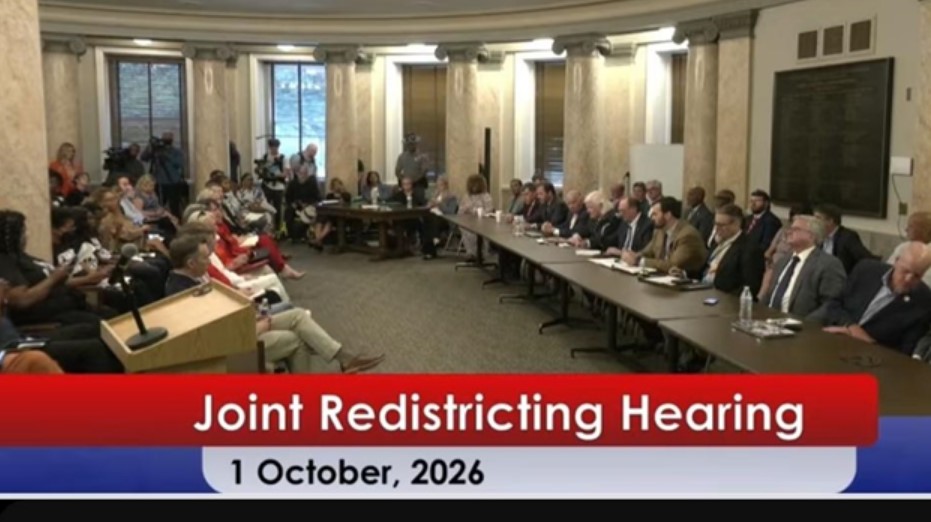
Screenshot from Mississippi Legislature livestream
Watch the full hearing online:
Mississippi Joint Redistricting Hearing – Oct. 1, 2026 https://www.youtube.com/live/cBl6OS-gY2k?is=55XnoWTfAL_Pb0q-
The Oct. 1 hearing was the last of eight public hearings held across Mississippi as lawmakers consider redrawing political districts in the middle of the decade.
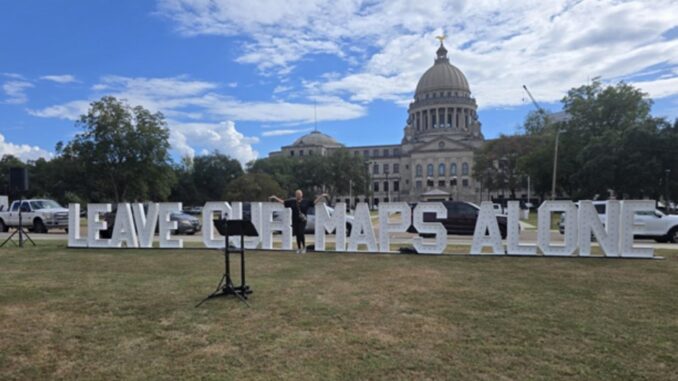
Earlier that day, opponents gathered across the street from the Capitol on the lawn in front of the Mississippi Supreme Court Building for the Rally for Fair Maps.
Massive four-foot letters spelling “LEAVE OUR MAPS ALONE” stretched across the lawn, creating a striking backdrop with the Mississippi State Capitol behind them.
The rally was followed by a march to the Capitol ahead of the 6 p.m. hearing.
Organizations participating in the day’s activities included the ACLU of Mississippi, Mississippi Votes Action Fund, Mississippi Center for Justice, One Voice, Mississippi Impact Coalition, JXN People’s Assembly, Mississippi Black Women’s Roundtable, Southern Poverty Law Center and Fair Fight Action.
Students from Jackson State University, Tougaloo College and Millsaps College were also among those who came to make their voices heard.
Opposition and concerns about mid-decade redistricting were not limited to Democrats.
Women affiliated with Republican organizations also testified. Lisa Givens, representing the Mississippi Federation of Republican Women, spoke about the country’s history of racial discrimination and cautioned against replacing one racial division with another. She also referenced the 14th and 15th Amendments.
The men of Omega Psi Phi Fraternity, Inc. showed up strong as well, with members testifying during the hearing about voting rights and representation.
But some of the most powerful words came from Mississippi citizens connecting the current debate to the state’s past.
Twenty-one-year-old Jackson State University student Jakari Holland drew a direct connection between what was happening inside the Capitol and what happened generations earlier.
“They did this 60 years ago because of racism and white supremacy,” Holland said.
For another citizen, the hearing brought back memories of an earlier struggle.
She said what was happening was “taking her back.”
“Here we are 50 years later fighting the same fight,” she said.
The comments reflected the history surrounding any debate about voting rights in Mississippi.
Sixty years ago, Black Mississippians were fighting discriminatory practices that restricted access to the ballot and diminished Black political power. The Voting Rights Act of 1965 became one of the landmark achievements of that struggle.
The latest redistricting debate follows the U.S. Supreme Court’s April 29 decision in Louisiana v. Callais. The Court held that Section 2 of the Voting Rights Act did not require Louisiana to create the additional majority-Black congressional district at issue and found the challenged map unconstitutional.
Shortly after the decision, Gov. Tate Reeves moved toward calling Mississippi lawmakers into a special session to consider redistricting. The special session was later canceled.
Reeves subsequently wrote on X that he expected “lawmakers to redraw congressional lines BETWEEN NOW and 2027 elections!”
That possibility has raised a fundamental question among opponents: Why redraw Mississippi’s political boundaries now?
Citizens packed the Capitol October 1 to provide their own answer.
They came from different generations, colleges, organizations and political backgrounds. They did not necessarily oppose redistricting for the same reasons, but speaker after speaker expressed concern about changing Mississippi’s maps in the middle of the decade.
Outside the Capitol, four-foot letters had already delivered their message.
Inside, Mississippians delivered it themselves.
Leave our maps alone.
Be the first to comment