
By Christopher Young,
Contributing Writer,
Visiting for a full hour with Mississippi Department of Transportation (MDOT) Central District Commissioner Willie Simmons yields so much information. It had been two and half years since my last visit to his offices on N. West Street in Jackson, and he had a lot to share. What began as a mission to learn more about the exceptionally low percentage of minority contracting, done by the agency that gets more contracting funds from the state than any other agency, took on a much broader perspective.
Starting with those numbers though, in FY2022, MDOT received just under $834 million dollars in contracting funds, and 2.02 percent went to minorities. In FY2023, they received $1.05 billion dollars, and 2.46 percent went to minorities. In FY2024, they received $1.14 billion dollars, and 2.28 percent went to minorities, and in FY2025, they received $1.29 billion dollars, and 1.48 percent went to minorities. Simmons has made clear he wants these numbers to improve, but despite being just one of three members that make up the Mississippi Transportation Commission, he hasn’t been able to deliver what we know he wants to. It’s a lot to take in, and when asked to dive into it, to discuss the barriers and what’s getting in the way of more equity, he was direct.
“Our goal is to change and increase the numbers of what you are reading – that is that we have very few minority and Black contractors that we have participating in the process. But I would say the system is…I would kind of describe it as a runaway freight train, and you must first stop the train, and then reverse it and go back. You don’t turn a freight train around. The system…and here we are talking about minority and Black participation, the system has been moving in this direction so long that you have to put the brakes on it to get a handle on it and redirect it to send it to where you want it to go. Even small changes can be challenging, and it takes time to make that work.”
He then discussed what could be considered a cultural change at MDOT. He is the first African American Commissioner, elected in 2020, “and right away the transportation commission has put on a new face, and I serve with two White Republicans who elected me as the Chairperson, and that is a phenomenal change in slowing that train down.” In 2020, there were no African Americans in top leadership positions at MDOT. Now, in addition to Commissioner Simmons, Terrance Yarborough took over as Human Resources Director in 2021 – 2,700 hundred employees, Earl Glenn became the Chief Engineer in 2024 – overseeing the entire contracting process – and this year Jada Kirk was promoted to Deputy Executive Director and serves as Chief Financial Officer.
MDOT partners with Systems Consultants Associates, an extraordinarily successful minority and woman-owned local business, to identify, recruit, and support Black and other minority contractors through its management of the Supportive Services Program at MDOT. They help bridge the gap between state government demands and minority-owned businesses. They offer free technical training, bidding and technical guidance. They host events that bring potential minority subcontractors face-to-face with prime contractors, and so much more.
Yet, just as a foundation is laid to make progress, along comes the Trump Administration with new rules for Disadvantaged Business Enterprises (DBE), codified in an Interim Final Rule (IFR) on October 20, 2025, and you guessed it – it removes the presumption of race and gender-based disadvantage, claiming they are unconstitutional. MDOT informed stakeholders by letter https://mdot.ms.gov/documents/Civil%20Rights/Public%20Notices/DBE%20IFR%20Letter%2010.20.2025%20updated%202.10.26.pdf.
Adding insult to injury, the rule requires a ‘re-evaluation’ of all existing DBE firms based on their ability to demonstrate individual disadvantage. Non-DBE’s are not impacted, and it rolls downhill, so now MDOT must play by those warped rules. Per one law firm, PilieroMazza, 639 comments were received during the public comment period. Now, with the rule finalized, those presumptions have been replaced with a requirement that all applicants submit a personal narrative with an individualized demonstration of social and economic disadvantage.
Just imagine, you are disadvantaged, you are trying to use available resources to attempt to compete in the contracting process, and you now have to recertify (costly and time consuming) and complete a narrative where you share your individual experiences; individualized evidence of discrimination, social barriers, denied opportunities, and other circumstances that contributed to your social and economic disadvantage.
Simmons shares that so many Black and other minority contractors have run into the closed doors on this runaway freight train, and therefore they have a lack of demonstrated experience and a lack of resources. He encourages those contractors to take advantage of more engagements, pre-bidding conferences – where they can learn about how joint ventures operate, which can create opportunities, and to attend small business training programs whenever possible.
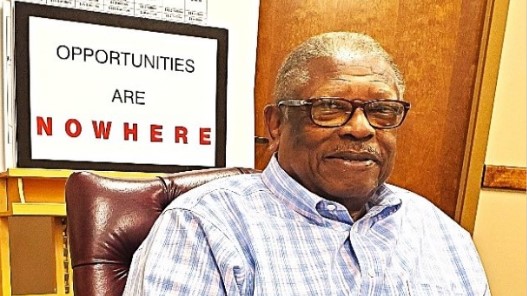
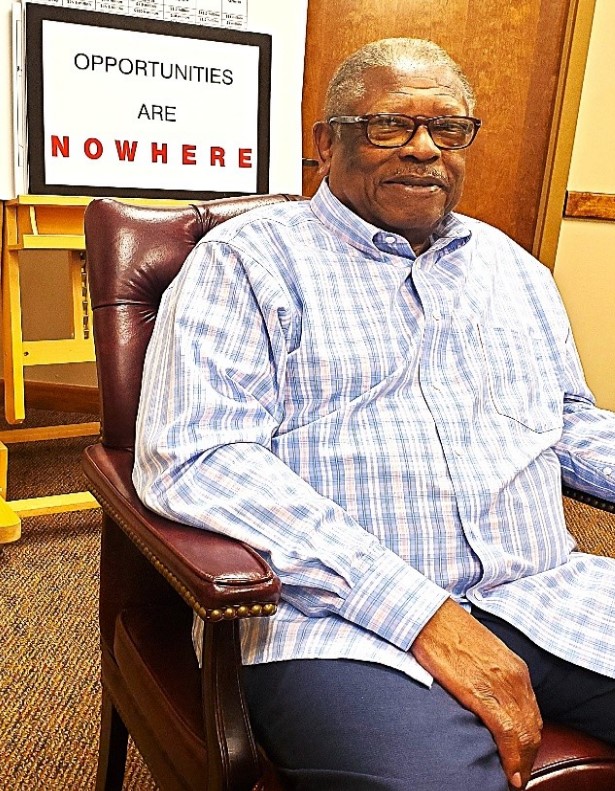
One critical question to be answered by the new Trump recertifications is if white women, or as the Mississippi Development Authority calls them – other non-ethnic women – will be able to justify their disadvantage. This group, perceived as disadvantaged, currently receives 81.79 percent of all minority contract- expenditures. The FY2026 Minority Participation Report has not yet been reviewed by this writer, yet there is every indication that Mississippi will continue to award the vast amount of taxpayer-funded contracting dollars to non-minorities. Despite our history of discrimination, and the new rules set by the Trump Administration, Simmons insists that the sign in his office that says, Opportunities Are Nowhere, actually says Opportunities Are Now Here. If change can ever come, he’ll have his hand on it.
Be the first to comment