
By Christopher Young,
Contributing Writer,
In moments of uncertainty, comedy and satire help communities process fear, challenge power, and find connection. Humor is deeply empowering. It gives us agency in the face of anxiety and lets us confront and even laugh at our worst fears.
That power is precisely why comedians so often become targets of political backlash, and why restrictions on satire are common in authoritarian societies. But how and why does humor shape the way we understand politics, culture, and ourselves when the news feels overwhelming?
On Friday, March 6, 2026, American Community Media’s Pilar Marrero moderated a lively conversation with three prominent comedians, actors and cultural voices who use humor to interpret and respond to turbulent times. Over sixty media outlets from around the world joined the Zoom call.
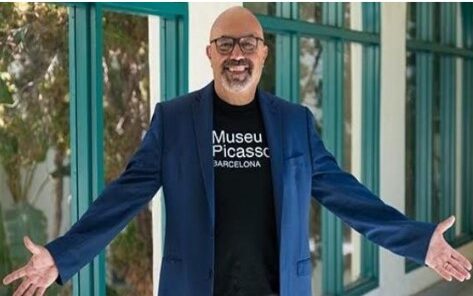
Herbert C. Siguenza, artist-in-residence at San Diego State University Arts Alive, and a founding member of the legendary Latino performance troupe, Culture Clash, was first to respond to the question – What role does humor play in helping people process uncertainty or fear? “This is what we do every day, use comedy as a salve, as an antibiotic against the sadness in the world. Humor is always a part of our culture. In fact, I’m going to a funeral right now, and there will always be although it’s sad, there will always be somebody who comes up to the altar and says something funny…there’s two types of people. Either they come up sad or they come up with a joke to break the ice. And everyone needs that, right, as a release. You’re sad, but you need to laugh. You need to laugh about and celebrate that person’s life. And so, I think humor is just part of our culture. It really is our savior to what’s going on in the world.”

Photo: www.linkedIn.com
Emil Amok Guillermo, journalist, humorist, and poet laureate, whose work blends political commentary, journalism, and satire across multiple media platforms, shared next. “Well, here’s the thing – humor comes out of pain. Humor comes out of tension. And when it’s so tense and the pain is so real and it’s just too much, that’s the perfect moment for humor. And that’s why, when the tension goes up, someone, you know, solicits or elicits a joke, and then you get the biggest laugh. It’s the antidote to all of that. And that’s why as a journalist for fifty years, humor has always been in the toolkit. But I was never a professional jokester or a comedian. I was a journalist. I was trying to get at the truth. I always use the Mary Poppins theory, you know, sugar, a spoonful of sugar helps medicine go down. I’ve always tried to use humor to engage in my columns a little bit, not too much, because I’m still ultimately telling a truth, a serious truth.”

Photo: www.canvasrebel.com.
Samson Koletkar, co-founder of the Desi Comedy Fest, the largest South Asian comedy festival in the United States, and founder of Comedy Oakland, may have surprised the audience of journalists with his comments. “Everybody’s talking about jokes and humor and comedians. I’ll start with the news media, because one of my favorite quotes is – if you don’t follow the news, you are uninformed. If you do follow the news… you’re misinformed! I find that very interestingly honest to say in front of an entire Zoom room of news people.”
He continued once the laughter subsided. “This is what we are talking about, right? Like for comedians, we see things and we say things. Somehow that filter is not in our brains. So that is the big distinction – humor is agreement. If I tell a joke and you laugh, it’s because you agree with me. And if you don’t agree, you don’t laugh. And that agreement is a very instant thing. You can’t plan for it. People are thinking things and then we come along and we say it out loud. We just structure the idea into words and we portray it. And if you guys agree and connect, then you laugh. And if you disagree and don’t connect, then the comedian goes back and figures a way to make it more connectable, improve the way they say things. I also have a secondary take on comedians. Sometimes they try to put themselves too high up on the horse, like we are the truth speakers. Like only as long as people are laughing. When they don’t, you change your truth a little bit as well.”
A question from La Opinion’s Araceli Martinez Ortega elicited an understanding of what is fair game for humor and jokes and what is not. The question, “Under the current circumstances, when we are seeing a lot of immigrant families suffering, when we are seeing immigrants dying in ICE custody, how can you make use of immigration without being insensitive?” Mr. Siguenza responded, “I’d like to answer because I’m Latino. I qualify. Personally, I don’t deal with it. You’re right. It’s so painful. It’s so real. It’s so personal. I can’t make fun of it. I can’t. I can’t think of jokes that will alleviate or make fun of or get laughter out of that. That whole theme is so dark. It’s like making death camp jokes, they’re just not going to go over…this administration has been so outrageous. So unreal that I can’t, I can’t put my finger on it as a comic. There are just some subjects that I just won’t go there.”
To view this entire national briefing, go to https://americancommunitymedia.org/media-briefings/what-makes-us-laugh-in-dark-times-humor-as-an-antidote-to-fear.
Be the first to comment