
By Christopher Young,
Contributing Writer,
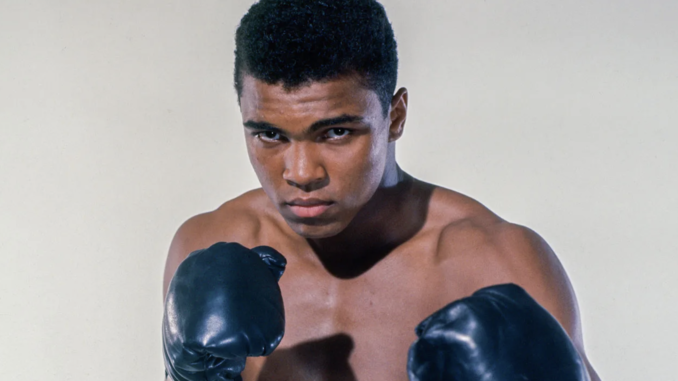
The fight ended on June 3, 2016, in Scottsdale, Arizona. No trunks, no gloves, no squared ring, no rope-a-dope – just a hospital bed, surrounded by his family. The greatest heavyweight boxer of all time succumbed to septic shock, dying of natural causes and was pronounced dead at 9:10PM Mountain Time. At 74, not having fought a professional bout in 35 years, and having suffered the debilitating powerlessness of Parkinson’s disease for 34 years, it was a merciful end for The Champ.
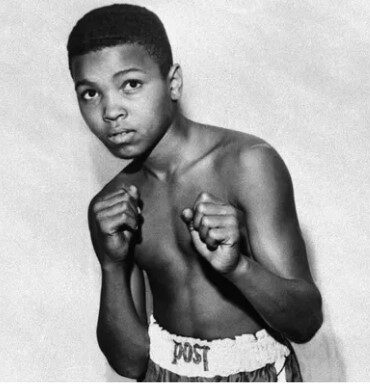
Ali was born in Louisville, Kentucky, January 17, 1942, to Cassius Marcellus Clay Sr. and Odessa Grady Clay. His name at birth was Cassius Marcellus Clay Jr. Eighteen months later, his only sibling, a brother, Rudolph Arnett Clay, was born.
Cassius Clay won his first professional fight at just 18 years old, defeating 30-year-old Tunney Hunsaker by unanimous decision in the 6th round. Per the Muhammad Ali Facebook page, Hunsaker said afterwards, “awfully good for an 18-year-old,” and the two remained lifelong friends. Just four years later, at age 22 in 1964, and just a few weeks after winning his first heavyweight title, he changed his name to Muhammad Ali. He had converted to Islam and joined The Nation of Islam. “He stated that his birth name was “a slave name,” adding, “I didn’t choose it and I don’t want it.” His new name, he noted, is “a free name” meaning “beloved of God.” The name Ali inherited from his father — Cassius Marcellus Clay — was in fact given to his dad in honor of Cassius M. Clay, a fervent abolitionist who graduated from Yale in 1832.
The namesake had “joined the antislavery movement and made the abolition of slavery his life’s work. According to “American National Biography,” Clay “developed an economic critique of slavery that some historians consider to be the most penetrating analysis of slavery produced by a Southerner.” During a political debate in 1943 he survived an assassination attempt, then published “Slavery: The Evil — The Remedy.” In 1845-1846 he published an antislavery newspaper, the True American, in the slaveholding town of Lexington, Kentucky, per YaleNews.com. Ali’s birth name had come from a fighter, a believer in fairness and equality, whose public refusal of President Lincoln’s request that he be a major general in the Union Army, led directly to The Emancipation Proclamation.
Muhammad Ali fought battles in and out of the ring. Due to his incessant bragging and rhyming predictions, sports writers gave him the nickname The Louisville Lip – we know what those writers looked like in the 1960’s. White America didn’t appreciate Ali’s religious beliefs, his refusal to be drafted into the Army, his opposition to the Vietnam War, or his civil rights activism. When he said no to the draft, he was stripped of his heavyweight title and boxing license. Convicted of draft evasion (unlike Captain Bone Spurs), he lost four years of prime-age fighting, but remained out of jail on bail, and ultimately won at the Supreme Court in 1971 – the Clay v. United States ruling stated that his conscientious objector status was valid, overturning his conviction.
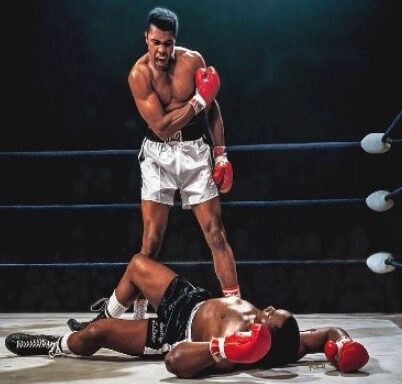
His championship fights remain legendary. Sonny Liston I (1964) & II (1965), Joe Frazier I – The Fight of the Century – (1971), Ken Norton I, II, & III (1973-1976), Joe Frazier II (1974), George Foreman – The Rumble in the Jungle – (1974), Chuck Wepner – said to have inspired the movie Rocky – (1975), Joe Frazier III – Thrilla in Manila – (1975), Leon Spinks I & II (1978), Larry Holmes (1980), Trevor Berbick (1981). Sixty-one professional bouts, 56 wins – 37 by knockout, and five losses, per BoxRec.com.
No one can ever forget his blazing footwork, lightning-fast hands, defensive prowess – dodging punches. A cultural icon. A global icon. His poetry. His proclamations. His charisma. Squarely in the turmoil and pain of the civil rights movement he stood strong, confident, and proud.
A lengthy list of biographers and historians all claim how much more he was than a three-time heavyweight champion. He used his platform to challenge racial injustice, redefine global sports activism, while commanding the world stage. The University of Louisville Libraries enshrine their native son – “Refusing induction into the U.S. Army during the Vietnam War cost Ali his prime athletic years and title, transforming him from a polarizing sports figure into a global martyr and anti-establishment icon.”
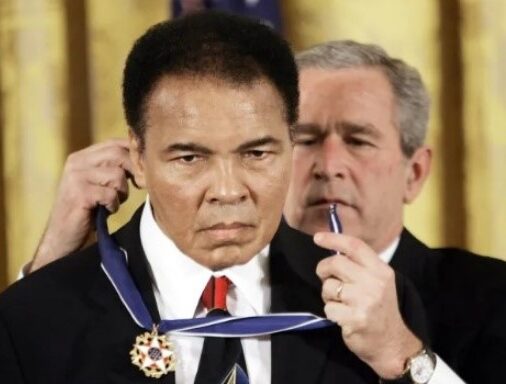
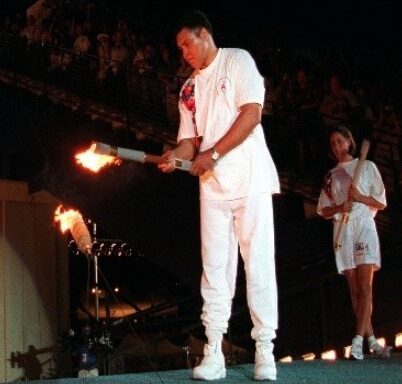
The Champ was often called on by U.S. Presidents. In 1980, Carter asked Ali to travel to Africa to secure support for an Olympic boycott of the Moscow games after the invasion of Afghanistan. In 1990, he went alone to Baghdad to meet with Saddam Hussein and secured the release of fifteen American hostages ahead of the first Gulf War. Ali was appointed a United Nations Messenger of Peace and travelled to hand-deliver food and medical supplies, advocate for debt relief, and spotlight humanitarian crises in Asia and Africa. His list of humanitarian works is exhaustive. So often when the ‘expert’ diplomats and negotiators failed, Ali succeeded.
As our nation suffers from an incalculable void of leadership, it’s important to remember a multi-faceted leader, a man, an African American man who sacrificed his professional career to protest the Vietnam War. The Greatest! Ten years on.
Be the first to comment