By Shauna Stuart,
For the Birmingham Times,
When the Rev. Otis Dion Culliver, pastor of Tabernacle Baptist Church, got the request to host the mass meeting for a national day of action to mobilize a new voting rights era, he knew the church had to heed the call.
In 1963, the historic church was the site of the first mass meeting of the Selma voting rights movement.
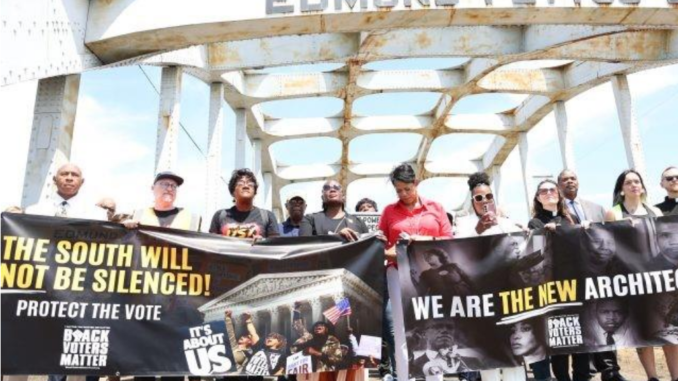
On Saturday, May 16, more than 60 years later, the church was the launch space for “All Roads Lead to the South,” a campaign for thousands of people to return to Alabama’s battleground cities of the historic voting rights movement as a clarion call to protest Republican-led states’ efforts to redraw redistricting maps in a way opponents say will weaken the power of the Black vote. The effort called for attendees to march across the Edmund Pettus Bridge in Selma, followed by a rally in Montgomery at the Alabama State House.
“So many national organizations felt the summoning in their souls to do something about what’s going on in our country,” said Culliver. “And of course, coming to Selma is symbolic, but it’s also inspirational. And Tabernacle has a special place in history in the movement. So we were honored.”
Organizers and parishioners rallied together to work down to the wire overnight on May 15 to prepare the church and get details in order. Saturday morning, the area outside the church was a groundswell. Buses and cars pulled into the surrounding parking lots as mass meeting attendees made their way to the side doors. Wearing white shirts with the phrase “history started here,” Tabernacle Baptist Church parishioners stood on the church steps and passed out water bottles as temperatures began to rise.
Outside the church, parishioners Verdell Lett Dawson and Margaret Broadnax sat behind a table, greeting attendees and inviting them to take coffee, donuts, and water.
“It’s a part of the mission of our church to offer hospitality to people who come here,” said Dawson. “This church is where the voting rights movement started with the first mass meeting in 1963 that Dr. Bernard Lafayette and Mrs. Amelia Boynton co-organized. It was also a memorial tribute to her husband, Samuel Boynton, upon his passing.”
Broadnax was a senior at R.B. Hudson High School when Selma’s marches for voting rights started. She says she attended school with LeRoy Morton, the 19-year old activist who was riding in the passenger seat with fellow civil rights Viola Liuzzo when she was shot dead on March 25, 1965 by members of the Ku Klux Klan after shuttling fellow demonstrators between cities after the third march from Selma and Montgomery.
“I never thought that I would see this day,” said Broadnax. “I thought that we were moving forward. Now, all the gains that we made since the Civil Rights Movement in ‘65 are starting to be eroded. It’s a dark day. It is really a dark day.”
“It moved so quickly,” said Brenda Brown, referring to the states that immediately pivoted to reassess voting maps after the April 29 Louisiana vs. Callais decision struck down a landmark civil rights law that increased minority representation in Congress– a move that politicians and voting rights activists say guts Section 2 of the Voting Rights Act.
Brown, a 20-year member of the church, says she was taken aback. “Our ancestors… everything they fought so hard for. (Now) they’re trying to reverse everything.”
Inside of the church, people filled the pews and lined the walls as they listened to faith leaders from around the country offer prayers to protect attendees who had gathered in the sacred house of worship and condemn the dismantling of voting rights protections that foot soldiers fought and died for more than 60 years ago.
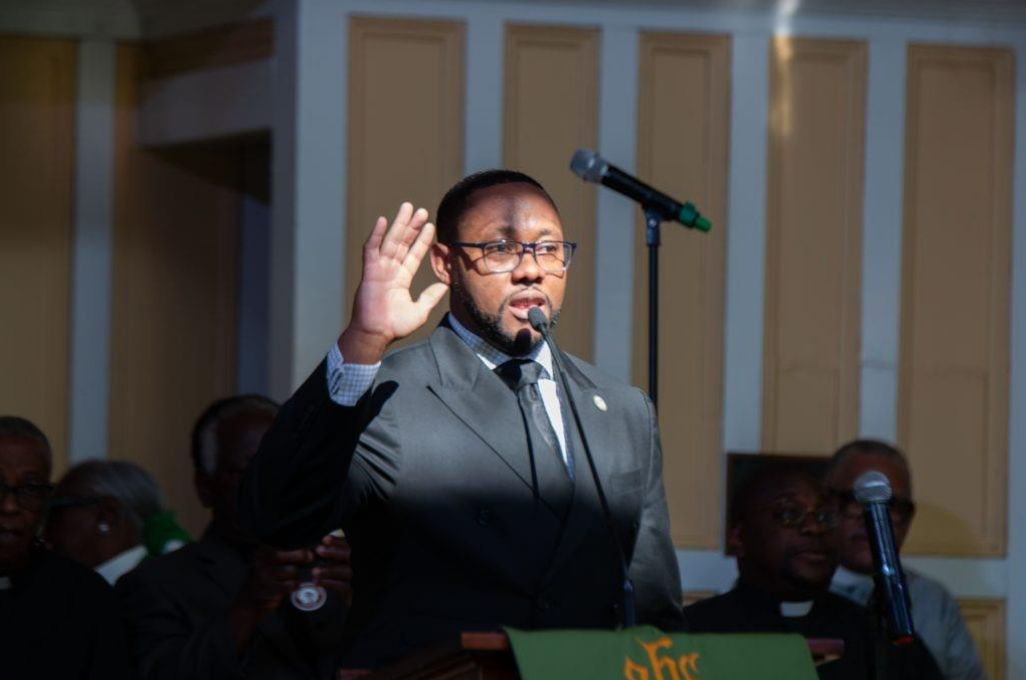
During his impassioned speech from the pulpit, Rev. Leodis Strong, the pastor of the historic Brown Chapel A.M.E. Church in Selma, recalled voter intimidation tactics in the Jim Crow South, including jellybean tests, where voting officials would ask Black people to count the number of jellybeans in a jar in order to register to vote.
“When they saw our collective power. They were afraid!” said Strong. “Now, there are no more jellybeans in jars, but jello and jelly in the spines of Congressmen who refuse to pass the John Lewis Voting Rights Act.”
“In the battle for the right to vote, the Black church has never been a spectator,” said U.S. Rep. Terri Sewell, who said efforts to erase fair voting maps take the country “back to the age of Jim Crow.”
To close the mass meeting, faith leaders offered a final benediction and prayer of protection as attendees prepared to march a mile from the church to the Edmund Pettus Bridge.
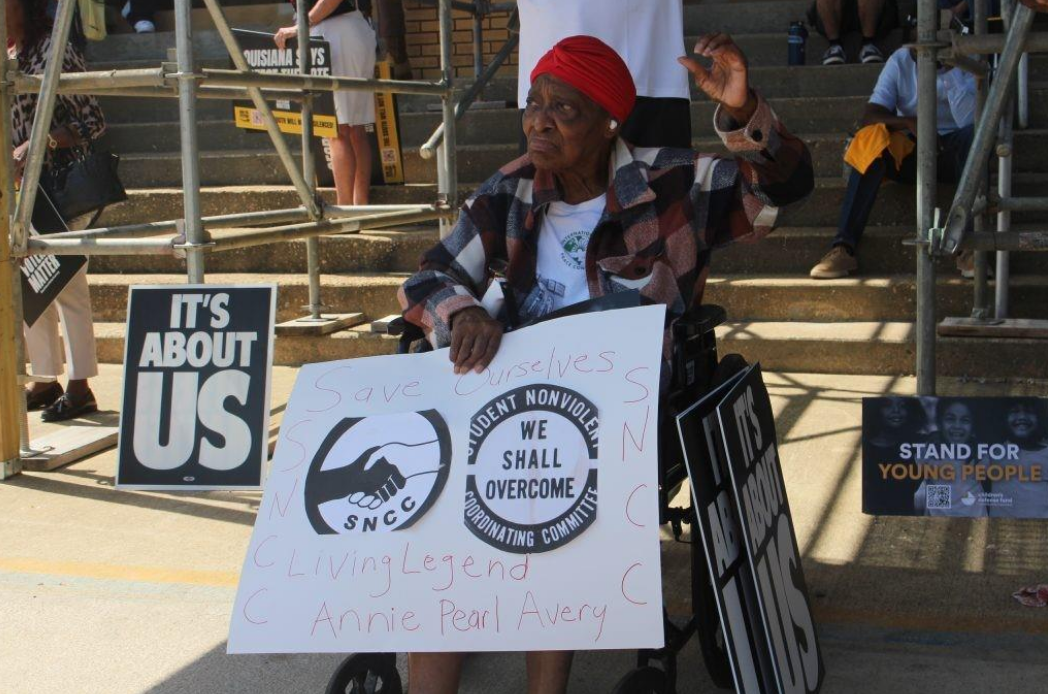
Outside of the church, Annie Pearl Avery sat in a wheelchair holding a sign with her fist raised high. Avery decided to get involved in the civil rights movement in 1961 after the Freedom Riders were attacked in Birmingham. She participated in sit-ins and marches, including the Bloody Sunday march across the Edmund Pettus Bridge on March 7, 1965.
Be the first to comment