

By Christopher Young,
Contributing Writer,
Since taking office, the Trump administration has targeted even lawful immigrants with recognized protections; and is pushing them into a category of “unauthorized.” This strategy accelerated after an Afghan refugee and CIA-trained former elite squad member was accused of shooting two National Guard members in Washington, D.C., an incident the administration used to blame refugees, restrict visas for 19 countries, and freeze Afghan immigration requests. At the same time, as the U.S. nears conflict with Venezuela, it is rescinding legal pathways and protections for Venezuelans and other communities.
The result is an unprecedented mass cancellation of legal status for people who followed every rule, creating a pipeline from lawful to “illegal” that could affect more than two million people and fundamentally reshape the meaning of legal immigration itself. Impacted groups include DACA recipients, TPS holders from multiple countries, and humanitarian parole that benefits Cubans, Venezuelans, Ukrainians, and many others.

Photo: Zocalo Public Square/Jake Fabricius
Pilar Marrero, associate editor of American Community Media and co-producer of the National Briefing Series, moderated a briefing, joined by seventy-five media outlets from around the globe. She began with the question: “How is the administration redefining what it means to be in the country legally?” UCLA Professor Hiroshi Motomura, co-director of the UCLA Center for Immigration Law and Policy responded, “It involves taking status away from non-citizens who have lawful status today. So, they have it today and they won’t have it tomorrow or some point in the future, if the administration gets what it wants. I think the first thing to understand is that U.S. law has many different lawful immigration statuses – citizenship, lawful permanent residence, or what some people call a green card. But it also has many statuses that I think sometimes people call in-between, they’re not long-term lawful statuses, but they come with work permits, and these statuses are lawful.”
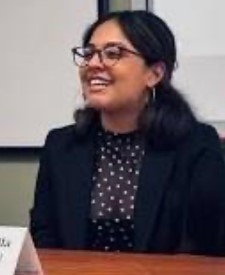
Photo: Instagram
Laura Flores-Perilla, a Staff Attorney at Justice Action Center, responded to a question about humanitarian parole. “This is a tool that administrations from both sides of the aisle have used for the last seven decades. It provides a safe pathway for entry to the United States, but also the ability to work in the US, in response to grave humanitarian crises that are happening in other countries. On the second day of Trump’s second term he announced he was terminating humanitarian parole. Deportation and/or expedited removal is the stated goal and has already begun.” She added that her agency has had some success in at least temporarily blocking some of these actions.

The next panelist, Adelys Ferro, Director of Partnerships at Latino Victory and the Executive Director of the Venezuelan-American Caucus, responded to a question about the years-long shifts in administration policies on Venezuelans. Prior to her remarks she reported that the Supreme Court of the United States will hear the challenges to the birthright citizenship question next year. “What I hear daily in the Venezuelan community is terror, fear, exhaustion, and betrayal. Venezuelan families have spent years doing everything asked of them. They register for TPS. They apply for work permits. They show up in court. They pay their taxes. They build small businesses. Their kids are in our schools, churches, and universities. Right now, 600,000 are at risk of deportation. One day we Venezuelans were welcome here, now we are disposable.”

The Honorable Jeremiah Johnson, former immigration judge in San Francisco and VP of the National Association of Immigration Judges, was recently let go as part of the Trump Administration’s purging of certain immigration judges. He was asked how his removal fits in with the administration’s broader efforts. “In the context of legality to illegality, people used to come to court, but now they are scared to come to court. If they fail to appear in court, it results in an order of removal. So, if people lose their pending status, it ends their process as asylum seekers, and by removing judges you remove the whole framework. You are a lawful resident unless I, as a judge say so, and so the process of review would be removed completely.”
 A woman, only identified as Andrea, for her protection, spoke next. She is a Dreamer and DACA activist/immigrant rights organizer. She came to the United States at age five and applied for Deferred Action for Childhood Arrivals. She is now 25 and her application is still on hold. She shared that she lives in the DC-Maryland-Virginia area and is working on a master’s degree in public policy. She spoke about the lack of stability. “This isn’t new. We’ve lived in fear for my whole life. People take things for granted, like renewing their license, and now with Real ID, I can’t do that. The Administration is telling us to self-deport. This is my home. My friends and family are here.” She was asked by the moderator if she had anything to share with journalists, and she said, “Please don’t forget that we are people. Please try to remember the humanity. There are lives at stake. Please try to remember how exhausting this can be for us.”
The entire, one-hour briefing can be viewed at https://americancommunitymedia.org/media-briefings/from-legality-to-illegality-how-the-trump-administration-is-reclassifying-lawful-immigrants-as-unauthorized.
Be the first to comment