
By Dr. Edelia J. Carthan,
Contributing Writer,
The first week of testimony in the federal trial challenging Mississippi’s 2016 airport takeover law, Senate Bill 2162, centered on one question: Why does the state want to take control of the board governing Jackson-Medgar Wiley Evers International Airport?
Over five days, attorneys presented testimony from elected officials, former state officials, airport administrators and an expert witness in political science. Internal memos, audits and legislative records were also introduced as evidence.
At the heart of the case is Senate Bill 2162, which seeks to change the composition of the Jackson Municipal Airport Authority (JMAA) board. While the law has not gone into effect, the City of Jackson still appoints a majority of the commissioners. The legislation seeks to expand the board to nine members, reducing Jackson’s appointments to two while giving the remaining appointments to state officials and surrounding jurisdictions.
Jackson Mayor John Horhn testified about the city’s ownership of the airport and the impact the legislation has had on local control.
Earlier in the week, jurors heard testimony from former performance auditor Samantha J. Atkinson, who was assigned to research the airport before SB 2162 was introduced. Her testimony included discussions of audits, financial reports and internal memoranda prepared during the state’s review of airport operations.
Several internal communications were introduced into evidence, including emails and text messages exchanged by state officials as discussions about the legislation moved forward.
Former Governor Phil Bryant’s Chief of Staff Joey Songy later testified about the development of SB 2162. During cross-examination, Songy acknowledged that he did not recall meeting with Jackson city officials, members of the City Council, Black legislators or other Jackson stakeholders before the legislation was passed.
Another major topic during the week was Southwest Airlines’ departure from Jackson.
An internal memo prepared by Bobby Morgan stated that Southwest’s decision to leave Jackson was not caused by the management of the Jackson Municipal Airport Authority. Instead, the memo cited national economic conditions, including the aftermath of the September 11 terrorist attacks, multiple recessions, rising fuel costs and changes in Southwest’s business model that required higher passenger volume.
Airport Chief Executive Officer Rosa M. Beckett testified that airport revenues are regulated by the Federal Aviation Administration and must be reinvested into airport operations. She also explained that federal grants typically require state and local matching funds and testified that the airport did not receive state funding approved by the Legislature in 2024 after the appropriation was vetoed.
Last week concluded with testimony from Dr. Byron D. Orey, professor of political science at Jackson State University, who testified as an expert in race, politics, voting rights, political behavior and legislative behavior.
Using decades of research, Orey placed SB 2162 within the broader history of Mississippi politics, discussing Reconstruction, the Mississippi Plan of 1875, the 1890 Mississippi Constitution, the Voting Rights Act of 1965 and legislative redistricting.
He explained the concepts of vote dilution, “cracking” and “packing,” describing how those practices can affect minority voting strength and political representation. He testified that reducing Jackson’s authority to appoint members to the airport board also reduced the political influence of the city’s voters.
In one of the week’s most significant moments, Orey testified, “The primary reason for the passage of SB 2162 was to remove the power of Blacks to appoint members to the airport board.”
He also testified that “The state treated Jackson differently than it treated other municipalities,” pointing to legislative actions involving Jackson compared with cities such as Tupelo and Meridian.
Outside the courtroom, Congressman Bennie G. Thompson, who attended portions of the trial, shared his reaction with The Mississippi Link.
“Obviously, it’s about taking Jackson’s largest economic asset, and they didn’t even give the city the courtesy of talking to its leaders. They came up with a rationale that is being disproved by the witnesses the Airport Authority has presented…. They tried to starve the airport to death by refusing to provide state funding, and despite that, they’re still doing a good job.”
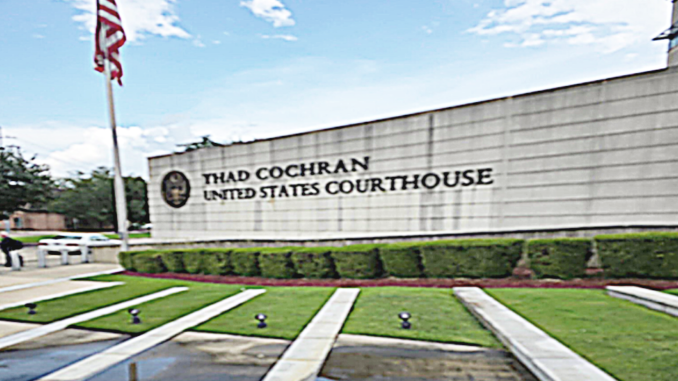
As the trial enters its second week, additional witnesses are expected to testify before U.S. District Judge Carlton Reeves as the court continues to examine the motivations behind Senate Bill 2162 and whether the law violated the constitutional rights asserted by the plaintiffs.
Watch my interview with Congressman Bennie Thompson here
Be the first to comment