
By Othor Cain,
Contributing Writer,
For generations, Black Mississippians have understood a fundamental truth about democracy: power is never simply given. It must be exercised.
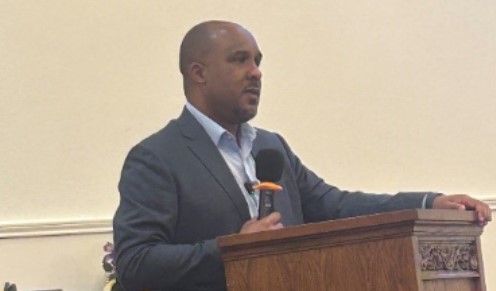
This November, Mississippi voters will make a decision that could reverberate far beyond the state line. District Attorney Scott Colom, the Democratic nominee for the United States Senate, is challenging Republican incumbent Cindy Hyde-Smith in a race that raises questions not only about party and politics, but about justice, representation and whether Mississippi’s Black electorate will use its considerable voting strength to demand something different.
Colom enters this race with something many political candidates cannot claim: a record, voters can examine.
A prosecutor focused on Accountability and Fair Justice
Scott Colom was elected district attorney for Mississippi’s 16th Circuit Court District in 2015 at just 32 years old, defeating an incumbent who had held the office for nearly three decades. He became the first Black person elected as the district’s top prosecutor.
His approach challenged the false choice that communities must choose between public safety and criminal-justice reform.
Colom has emphasized prosecuting violent crime while directing resources away from treating every offense as though it deserves the same response. His campaign says he has won 94 percent of his trials, secured convictions in more than 15 high-profile murder cases and helped close a record number of cold cases. He also prosecuted a sheriff accused of abusing his position — even though that sheriff was a fellow Democrat.
That last point matters.
Accountability cannot mean holding only the other political party accountable. Justice worthy of the name cannot change depending upon a person’s connections, wealth, race or political affiliation.
Colom has summed up that philosophy simply: no one should be above the law, and no one should be beneath its protection.
That is the kind of justice Black communities have demanded for generations.
But where is Washington?
There is another story developing around Colom’s campaign that deserves the attention of Black voters.
While some prominent Democrats and organizations have rallied behind him, including Congressman Bennie Thompson, Senator Angela Alsobrooks and several Black political organizations, the national Democratic establishment has not treated Mississippi like one of its premier Senate opportunities.
In July, the Democratic Senatorial Campaign Committee announced a $40 million investment across 10 states. Mississippi wasn’t one of them.
Think about that.
Mississippi has the highest percentage of Black residents of any state in America, yet it was omitted from that major DSCC investment. The committee did not answer Mississippi Today’s question about why the state was excluded.
Meanwhile, Colom has demonstrated an ability to raise money and attract grassroots support. He has also received significant outside support: American Bridge 21st Century announced a $2 million investment in the Mississippi race, while BlackPAC and other organizations have backed his candidacy.
So the story isn’t that Democrats have completely abandoned Scott Colom. They haven’t.
The more troubling question is whether some national Democratic power brokers have already decided which states are worth fighting for — and whether Mississippi’s heavily Black electorate is once again expected to deliver votes without receiving an equivalent level of national investment.
Black voters have every right to ask that question.
When you can’t beat the record, attack the man
Cindy Hyde-Smith’s campaign has taken an extraordinary step in its effort to define Colom.
Her campaign created ColomForSenate.com, a website deliberately fashioned to look like a campaign site for Scott Colom, whose actual campaign website is ScottColom.com.
This wasn’t an anonymous internet prank. Hyde-Smith’s campaign publicly acknowledged creating the site as an attack vehicle against Colom.
The website portrays Colom as a radical and attacks his positions and prosecutorial record. One of its most inflammatory claims concerns transgender medical care for minors. But reporting examining the document cited by the attack site found that the letter being used as evidence did not actually mention surgery.
Voters should ask themselves a simple question:
If Cindy Hyde-Smith has a record she is proud to run on, why does her campaign need a website masquerading as her opponent’s?
Mississippi deserves a debate over records, policies and results, not political trickery.
Cindy Hyde-Smith Has a record too
Hyde-Smith’s record deserves scrutiny.
She supported the massive 2025 federal tax-and-spending legislation that reduced future Medicaid spending. Mississippi hospital leaders warned that changes contained in that law could cost hospitals in the state hundreds of millions of dollars and threaten already struggling rural facilities.
Those aren’t abstract Washington numbers.
For Black Mississippians, rural Mississippians and working families, access to Medicaid, a nearby hospital, nursing-home care and affordable health care can determine whether a family survives a medical crisis financially or whether a community loses one of its most important institutions.
Hyde-Smith has also opposed major federal voting-rights legislation, including legislation designed to strengthen the Voting Rights Act.
Black Mississippi has not forgotten 2018.
During that Senate campaign, Hyde-Smith was captured on video saying that if a supporter invited her to a “public hanging,” she would be on the front row.
In another controversy that year, she joked about making voting “a little more difficult.”
Those remarks did not occur in a historical vacuum.
They occurred in Mississippi — a state where Black citizens were beaten, terrorized and murdered for attempting to exercise the right to vote.
Hyde-Smith defended herself at the time and said criticism of the hanging remark was being twisted for political purposes. But Black voters have the right to decide for themselves what those words revealed and whether her subsequent record has earned their confidence.
The Black vote is not a side story. It may be the story.
Here is the political reality that should command national attention:
Black people constitute roughly 37 percent of Mississippi’s population, a larger share than in any other state.
The Associated Press recently reported that Black voters typically account for roughly one-third of Mississippi’s November electorate. Colom’s path to victory depends heavily on increasing that participation while also winning enough support from white, independent and crossover voters.
That means churches matter.
Barbershops matter.
Beauty salons matter.
HBCUs matter.
Fraternities and sororities matter.
Community organizations matter.
And, above all, turnout matters.
For decades politicians have analyzed the Black vote as though it were merely a number on an election-night spreadsheet.
It is more than that.
The Black vote represents descendants of people who were once legally prohibited from voting. It represents the legacy of Fannie Lou Hamer, Medgar Evers and countless unnamed Mississippians who risked jobs, homes, livelihoods and lives to claim citizenship in a state determined to deny it.
This November, that history meets the present.
Mississippi does not have to wait for Washington’s permission
Scott Colom’s candidacy presents Mississippi with an unusual opportunity.
A Black Democratic prosecutor from north Mississippi who has repeatedly won elections in a politically competitive district is asking voters to judge him on his record rather than the letter beside his name.
He is running against an incumbent senator with substantially more cash on hand, the advantages of incumbency and the backing of the Republican establishment.
And some powerful national Democrats still appear reluctant to make Mississippi the kind of financial priority that activists believe it could become.
Maybe Washington believes Mississippi cannot change.
Black Mississippi has heard that before.
People said Mississippi couldn’t change before the Freedom Summer.
They said Mississippi couldn’t change before the Voting Rights Act.
They said Black candidates couldn’t win offices that had never been held by Black Mississippians.
History changed because ordinary people stopped waiting for powerful people to believe in them.
This election should not be reduced to electing Scott Colom because he is Black, nor rejecting Cindy Hyde-Smith simply because she is Republican.
It should be about records.
What has Scott Colom done with the power voters already entrusted to him?
What has Cindy Hyde-Smith done with hers?
And which candidate is more likely to protect Mississippi hospitals, defend access to the ballot, fight corruption, pursue fair justice and make Washington pay attention to communities that have been ignored for too long?
Those are questions every voter should answer. My answer is a resounding Scott Colom.
But Black voters in Mississippi should understand something especially important:
You are not a political minority in this election. You are potentially the deciding force.
Washington may underestimate Mississippi.
Political strategists may underestimate Mississippi.
PACs may decide their money is better spent somewhere else.
But on Election Day, none of them get to cast Mississippi’s ballots.
Mississippians do.
And if Black Mississippi turns out in historic numbers this November, the nation may wake up the next morning realizing that the political map of Mississippi was never as permanent as Washington assumed.
Be the first to comment