
By Dr. Edelia J. Carthan,
Contributing Writer, The Mississippi Link,
Mississippi is once again standing at a crossroads, with a U.S. Senate election that could change the state’s political history.
Nearly a week after the November 3 election, Democrat Scott Colom held a narrow lead over Republican incumbent Cindy Hyde-Smith in a race that remained uncalled. As of November 9, Colom led by 2,574 votes, according to the Associated Press, with thousands of ballots still awaiting final review.
If Colom wins, he will become Mississippi’s first Black U.S. senator elected by popular vote and the first Black person to represent the state in the Senate since Blanche K. Bruce left office in 1881.
The contest carries a remarkable political irony.
In 2023, Hyde-Smith blocked Colom’s nomination to a federal judgeship in Mississippi’s Northern District. President Joe Biden nominated Colom, then a district attorney, with support from Republican Sen. Roger Wicker. Hyde-Smith refused to return a favorable blue slip, effectively stalling the nomination.
On election night, Hyde-Smith reminded supporters of that decision, declaring, “I blocked Scott Colom from being a federal judge. And you blocked him from being a U.S. Senator.”
But that declaration came before the final votes were counted.
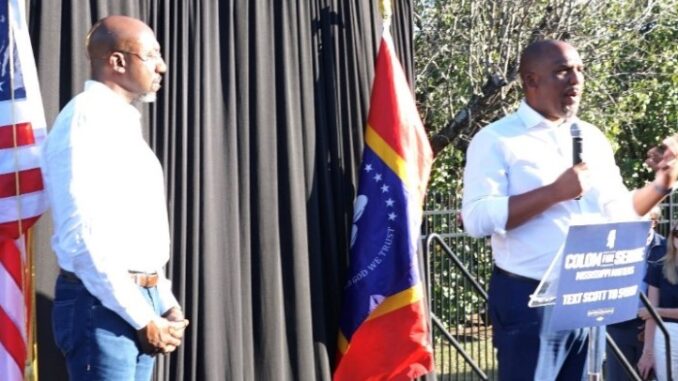
Colom, speaking with reporters after the election, placed the attention on Mississippi voters rather than himself.
“It’s not about me. It’s about the people of Mississippi,” Colom said, crediting volunteers and ordinary citizens who knocked on doors, distributed campaign literature, and encouraged participation.
His election-night message also emphasized protecting the ballot.
“We are going to fight to protect every vote. We are going to make sure your vote counts,” Colom told supporters.
The statements carry particular significance in Mississippi, where generations of Black citizens fought for voting rights that were repeatedly denied through law, intimidation, and violence.
A changing political landscape
Former Jackson Mayor Tony Yarber pointed to narrowing margins in recent statewide elections, comparing the 33.8-percentage-point gap in the 2015 governor’s race with 3.2 points in 2023 and less than one point in this year’s Senate contest.
“The map has changed, Family!” Yarber wrote on Facebook, noting that voter participation has grown from approximately 725,000 in 2015 to more than 930,000 in 2026.
While the elections involved different candidates and offices, the figures illustrate growing competitiveness in recent statewide contests.
Forrest County and the struggle for voting rights
One of Colom’s notable victories came in Forrest County, home to Hattiesburg. Reported returns showed him receiving 12,064 votes compared with Hyde-Smith’s 9,749.
The county is named for Nathan Bedford Forrest, a Confederate general, slave trader, and early Ku Klux Klan leader.
Hattiesburg was also a center of civil rights organizing during Freedom Summer in 1964, when volunteers established Freedom Schools and organized voter registration efforts.
Forrest County civil rights leader Vernon Dahmer helped Black residents register despite threats and intimidation. Klansmen firebombed his home in January 1966, and Dahmer died from his injuries.
Sixty years later, a Black Senate candidate has carried the county where Dahmer fought for voting rights.
A 145-year absence
Mississippi once led the nation in Black Senate representation.
Hiram Rhodes Revels became America’s first Black U.S. senator in 1870. Blanche K. Bruce followed in 1875, serving until 1881. Both were chosen by the Mississippi Legislature before the Seventeenth Amendment established direct election of senators.
Those Reconstruction gains were followed by systematic efforts to suppress Black political participation.
The Mississippi Plan of 1875 employed intimidation and violence, while the state’s 1890 constitution-imposed poll taxes and literacy tests that helped disenfranchise generations of Black Mississippians.
Today, Mississippi could elect its first Black senator by popular vote, ending a 145-year absence.
But history cannot be declared before the votes are counted.
Election officials must finish reviewing eligible absentee and affidavit ballots before counties certify their results.
Hyde-Smith declared on election night that Colom had been stopped. Colom has emphasized the importance of protecting every vote.
The final count will determine the outcome.
Mississippi stands at another crossroads, and its next chapter is still being written.
Be the first to comment