
By Desare Frazier,
Mississippi Public Broadcasters,
Jackson State University is entering a new era of leadership as a familiar face takes the helm to break a five-year cycle of rapid presidential turnover. Dr. Denise Jones Gregory, a JSU alumna and accomplished organic chemist, assumed the presidency in April 2026 with the overwhelming support of a campus community eager for a leader from its own ranks.
Gregory returned to her alma mater in 2024 as provost following a distinguished academic career in Alabama, where she served as a professor and associate provost at Samford University.
In this conversation, she discusses stepping into the presidency, the challenges ahead, and her vision for preparing JSU students to compete in a global economy.
Frazier: You stepped into this role in April, but you were with the school before. You were provost and vice president of academic affairs. Tell us what it was like applying for the job and then finding out you got the job?
Jones-Gregory: Yes. So, I want to start first of all by just saying how grateful I am to be able to sit in this space that I am, to serve as the 14th president of Jackson State.
You know, I’m originally from Columbus, Mississippi, grew up here, born and bred in the state of Mississippi, went to Jackson State as an undergraduate, majored in chemistry.
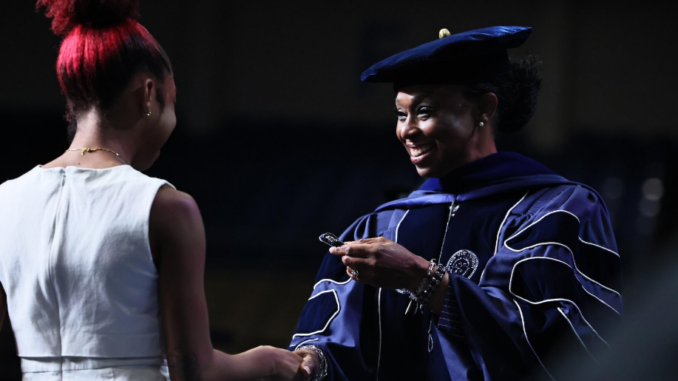
My parents went to Jackson State, my husband went to Jackson State, my sisters went to Jackson State, and just recently my nephew, I was so grateful to be able to pass him his diploma, graduated from Jackson State, three generations.
It’s always been a place that has poured into me from the very beginning. Since I was a five-year-old kid, coming with my parents to Jackson State football games as a kid growing up, watching the Sonic Boom of the South.
Worked in higher-ed for 25 years and it was always pulling at me or tugging at me that Jackson State is the place that I call home and want to come back. I will say the larger transition came from provost to interim president.
Frazier: Did that give you more confidence, make you more at ease the previous roles that you were in?
Jones-Gregory: Absolutely. Absolutely. The interim president, I was very ambitious in the interim president role. I was continuing doing projects and working on other things that most presidents would work on.
It really was more of a title change for me. Having the opportunity to be able to serve as interim president really gave me the confidence and really it was more of an opportunity for exposure for me.
Frazier: Jackson State, as you know, has had four presidents in five years. One thing that the alumni, faculty, and staff, when this position became available again, were really adamant about was getting someone who knew Jackson State because all the other presidents had come from other places. And you were born and bred, as you said, in that culture of Jackson State.
How do you think that makes students, faculty, and all of those who were cheerleading for this, that it happened?
Jones-Gregory: You know, it was so great to see the warm welcome from so many people, alums, friends, parents, students, in recognizing that Jackson State is a powerhouse.
It’s a place that can pour into, as we say, challenge our minds in changing and giving opportunities for so many people. And so I think the stability of having someone that’s been a graduate of Jackson State, I’m excited to serve as the first alumna.
Female president, alumna of Jackson State as well. And so having those connections, I think, brings back some level of security for our stakeholders.
I’m a very approachable person and know quite a few people because of the fact that I’ve grown up in the culture. And so, I think people having someone that they can actually talk to, and not that they couldn’t before now, but people that they may know personally on such a larger scale has really been resonating with our stakeholders, in particular students and parents, alums.
Frazier: All eyes are on you. That’s a big spotlight because of what has happened in the recent past. What have you been doing so far?
Jones-Gregory: It’s praying every day, right? Asking the Lord to give me guidance, to give me wisdom. Recognizing that everyone isn’t necessarily supportive of the decisions you make, but hopefully they understand and have the best interest in trusting me that I have more information.
Sometimes when I make decisions, it’s because of more information that I may have.
Frazier: Have you been able to make any changes or do anything that you have set out to do in these early days?
Jones-Gregory: Graduation, commencement exercises, and then the next thing, we rolled right into were budget requests in terms of our funding for the upcoming school year. Those are usually done in mid-May. So, one of the things that I recognize as important is how do we value our employees?
So, all of our faculty will receive $2,000 increase and then, the way that I was able to do that for staff members, because I wasn’t able to do $2K, we did $1,000 for our employees. So, I’m excited about that, being able to share that, and you’re probably the first to hear that.
Frazier: I know you have an agenda. What is at the top? Maybe the first three things?
Jones-Gregory: Yeah, you know, I’m very transparent about the news in terms of housing concerns at Jackson State. And so how do we… You’ve got a project underway, right?
We do, and I’m excited to share that project. We have our MacAllister-Whiteside dormitory, we’re renovating that. We’re changing that to suite style. We’ve completely gutted the entire building, taking out all the walls, 335 beds. We’re bringing back to campus for the fall of ‘27.
We have our Palisade Apartments, which are apartments that are on the southwest side of campus. There are 10 apartment buildings that Jackson State owns that we had to move students out of in 2024. But we are rehabbing a few of them at a time, bringing beds back to that inventory. And hopefully that will be done by this upcoming spring. So, increasing the bed count is crucial for us at Jackson State.
Part Two Title:
“Strengthening JSU: Safety, Support, and Strategic Partnerships Under President Gregory’s Vision”
In the second part of our conversation, President Denise Jones Gregory talks about the steps Jackson State University is taking to make the campus safer, stronger, and more supportive for students. She describes new safety improvements, updated technology, and efforts to ensure students feel secure in their daytoday lives.
She explains how the university is helping students resolve conflicts respectfully and offering resources that promote emotional wellbeing. Gregory also highlights growing partnerships with businesses and community organizations that create opportunities for students to succeed academically and professionally.
Her vision combines stability, innovation, and a strong commitment to the students and families who trust JSU with their futures.
Jones-Gregory: This past year we were number 15 in terms of HBCU’s and so we want to move on up and continue to do that and so you know in terms of how we do that is going to be crucial.
Another thing that I want to do is ensure that all of our stakeholders know what it is or what’s needed, that everyone understands the metrics that are needed, what it’s going to take for everyone, the university and outside the university to help us do that.
Frazier: Campus life, safety, on campus arguments that ended up with someone being shot, and so forth. You have your police department on campus. What are you looking at to make people feel more secure, parents feel more secure, children feel more secure?
Jones-Gregory: Yes, thank you for that. As a mother with a daughter on a college campus, safety is priority for me. One of the things I first did when I was interim, was that I took a tour around campus at night with my public safety team, as well as with our facilities team, and just kind of drove around campus to look to see, you know, what does it look like?
What does it feel like at nighttime to really be on our campus? How safe do I feel.
We did a lighting project across campus, about a half a million dollars, where we changed out all of our lighting to make sure that everything, what one-working, and then those places that may have been working, increasing the wattage in terms of the lighting capacity that we have on campus.
We upgraded our camera systems and then those that aren’t then what were the next steps that we need to take to get those fixed.
So those were major steps that we took in terms of funding in recognizing the importance of safety on our campus. Also, our emergency call boxes as well.
We want to ensure that those are all working and students will feel safe and make sure that when they do push the button or need to push that button. That it actually will respond and go to our public safety to ensure that they are being attended to when needed.
You’re absolutely right. How do we do that and ensure that all of our people on campus feel safe? Again, federal funding that we were able to use to assist us with some of those campus upgrades on campus.
Frazier: What about increasing the number of officers? How many do you have now?
Jones-Gregory: I won’t give you the exact number, but it’s somewhere between 10 and 14 certified officers on our campus. We also have the same in terms of our security. We have two levels of people that are part of public safety, and then we have an administrative team.
I will share that we’ve assisted in helping with our public safety officers. We have upgraded the technology that they’re using. We’ve also upgraded their police cars, their cruisers that they need and just most recently, you’ll see when students come back, we’ve also purchased Segways, which are the little motorized, kind of stand-up bikes that we can use on campus.
We want to see more foot traffic in the central part of campus for our public safety officers. They just started, I guess, training on them during the summer while students aren’t here, and I’m seeing them now.
Frazier: One thing that happens on campuses. When students have parties, there are people from the community that want to be there. Are you cutting that off? Are you making everyone show ID? How are you handling that?
Jones-Gregory: For our spring fling we just had. We did have it blocked off, areas that were blocked off and students showed their ID in order to get in. Even though it’s outside, we kind of have a roped off area for that, that we did that for and recognizing that.
We do want to ensure that we’re keeping those to just our students in those particular places. In terms of the other larger ones, we have to look at ways that we can ensure that these are just our students that are there.
We do have events where we have officers that are there that are open to the public where they can come in and they are always there at those particular places and watching and standing by.
Frazier: One more question in that regard. Are you teaching anger management classes? Conflict resolution?
Jone-Gregory: Yeah, within our Student Affairs Office, we have ways that students can do conflict resolutions. We have our mental health facility, our Latasha Norman Center on campus and we also help students in terms of how they deal with their emotions, and how they work with people.
It’s extremely important that we teach civility, civil discourse, recognizing that we can agree to disagree and how do we handle that.
Frazier: I noticed that JSU has been more involved in partnerships that are STEM-related. What other partnerships? Tell us more about the STEM.
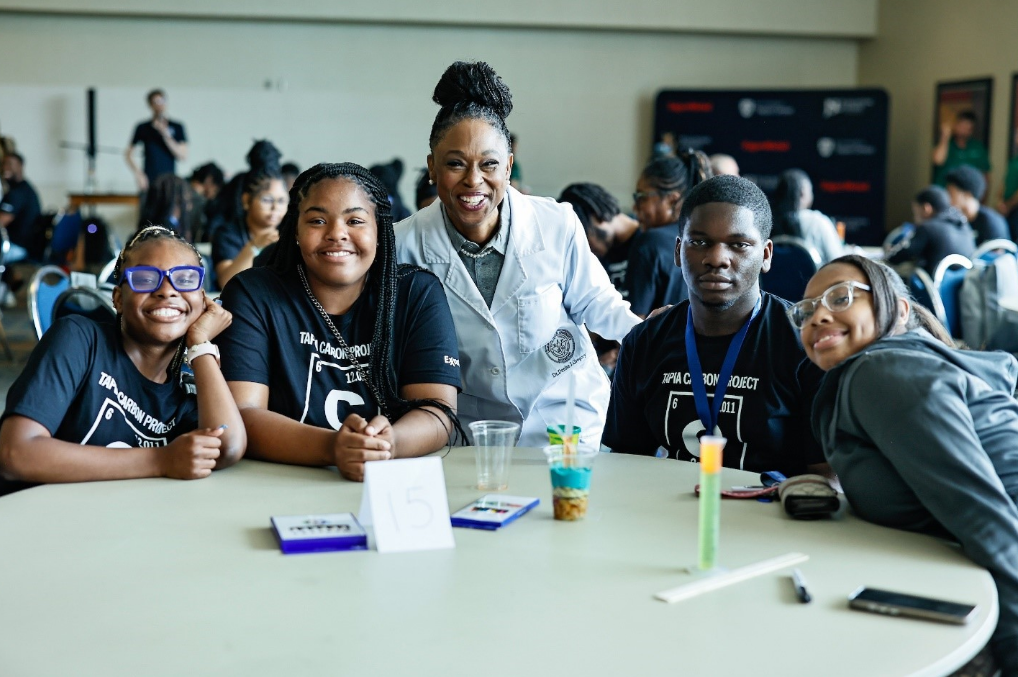
Jones-Gregory: Yeah, for sure! So, I’m a STEM graduate. I majored in chemistry at Jackson State. My PhD is in organic chemistry, so I’m an organic chemist. Those are extremely important for us to create those STEM relationships.
But outside of just that, our School of Business is doing great work with a lot of community-based organizations in terms of our Bank Plus agreements that we have out.
We also do some great work with other programs that are out there. Our public health community is also doing work in the community with partnering with our Jackson Heart Study.
We also have the work that’s going on in our School of Education, with Jackson Public Schools, with students with JPS that are coming in that are also doing their work.
Each one of our academic spaces has great partnerships across the campus outside of just STEM. Course our AI initiatives that are coming up, cyber security, all those different places, workforce development, supply chain management is also a new program at Jackson State.
We really want to highlight and ensure that we’re creating opportunities for students to have a footprint in all those areas.
Be the first to comment