
By Edelia “Dr. Jay” Carthan,
Contributing Writer,
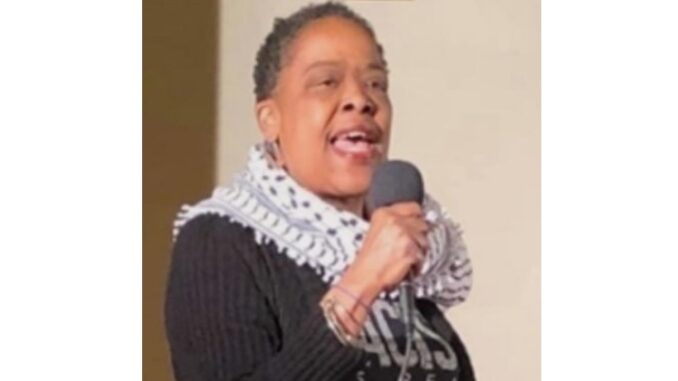
For decades, Jaribu Hill has stood where justice is most contested, on the front lines. A civil and human rights attorney, author, and international spokesperson, Hill has built a career defined by courage, conviction, and an unwavering commitment to the people she serves.
As founder and executive director of the Mississippi Workers’ Center for Human Rights, she has provided legal representation and advocacy for hundreds of workers across the state. Her work has helped drive the adoption of “zero tolerance against hate” policies in workplaces, while amplifying the voices of those too often ignored.
Hill’s impact extends far beyond Mississippi. In support of human rights struggles, she has traveled across Asia, Africa, Europe, and the Caribbean, bringing global attention to local injustices and connecting movements across borders.
For many in the community, her presence is constant. At marches, protests, and moments demanding accountability, she shows up, not occasionally, but consistently. She is not just a leader in title, but in action.
From courtrooms to communities:
Hill’s advocacy has shaped some of the most critical justice movements in recent history. She played a role in the broader efforts that led to the removal of Mississippi’s state flag bearing Confederate symbolism, a historic shift rooted in years of sustained activism.
Her work with workers at Nissan’s Canton, Mississippi plant brought international attention to labor rights in the South. Standing alongside employees, she advocated for fair wages, safe working conditions, and the right to organize, challenging corporate practices and elevating worker voices on a global stage.
Her legal career also includes significant victories, including a judgment against the Ku Klux Klan in South Carolina, and advocacy for Mississippi Delta families fighting for educational equity.
Hill has served as a legal observer and cultural artist during the Women in War Crimes Tribunal in Tokyo and is the author of Haunting Mirrors, a poem honoring victim of sexual slavery. Her writings and legal scholarship have appeared in prominent publications, including law reviews and academic journals.
Admitted to the U.S. Supreme Court, she has also served as a Special Master in Washington County’s Chancery Court and as a municipal judge in Hollandale. In addition, she hosts “Talking Rights with Jaribu,” a weekly radio program on WDSV 91.9 FM, continuing her mission to educate and empower.
In addition to her extensive legal work, Hill serves as a board member of the Mississippi Immigrants Rights Alliance, where she continues to advocate for immigrant communities and equitable access to justice.
During Women’s History Month, honoring Hill is a recognition of a life dedicated to justice in all its forms. Her work reflects resilience, leadership, and an unshakable commitment to truth. She is not only present in historic moments, she helps shape them.
Her impact can be seen in policies changed, cases fought, and communities strengthened. But perhaps most powerfully, it is felt in her unwavering presence, standing with the people, time and time again.
Hill herself reflects that legacy with humility and purpose: “I am so honored to be part of this special issue of The Mississippi Link, in honor of Women’s History Month. I stand on the shoulders of courageous warrior women, who fought for the human rights and dignity of the most vulnerable. I am grateful for the lessons passed on by Fannie Lou Hamer, Ida B. Wells and so many others. Their lives and their work propel me forward.”
Her work has also inspired others across movements. Danyelle Holmes, Senior National Social Justice Organizer for The Poor People’s Campaign, said: “What Jaribu Hill represents deserves more than honor, it calls for us to tell the truth about the kind of courage it takes to stand in Mississippi and not bow. She is more than an attorney; she is a fierce advocate and a revolutionary, shaped by the pain of our people and committed to transforming that pain into power. Like those before us who refused to be turned around, she stands firm in the fight for dignity, justice, and liberation, reminding us that freedom is not given, it is fought for, every single day.”
A song born from resistance, Hill’s advocacy has also taken a creative form. In response to the treatment of Eddie Carthan during the early 1980s, when he served as the town’s first Black mayor and faced intense political and legal opposition, she wrote a song to bring awareness to what many saw as efforts to undermine his leadership and dismantle progress.
By capturing this moment in history through music, Hill not only documented injustice but also underscored a decades-long commitment to standing with those targeted by systems of power.
“Tchula, Mississippi—Slavery in the Delta!”
by Jaribu Hill
Tchula Mississippi, plantation town
Whole lot of slavery going down
Tchula Mississippi, plantation town
Whole lot of slavery going down
Well they barricaded City Hall
They tried to back the mayor against the wall
You know the Governor and the Klan
They took the land back by hand
The mayor on trial
cause they didn’t like his style
Ohhh Tchula Mississippi, plantation town
Whole lot of slavery going down
Tchula Mississippi, plantation town
Whole lot of slavery going down
Be the first to comment