
By Curtis Nichouls Jr.,
Guest Writer,
On a beautiful Sunday afternoon, February 22, 2026, the historic campus of Tougaloo College was alive with purpose.
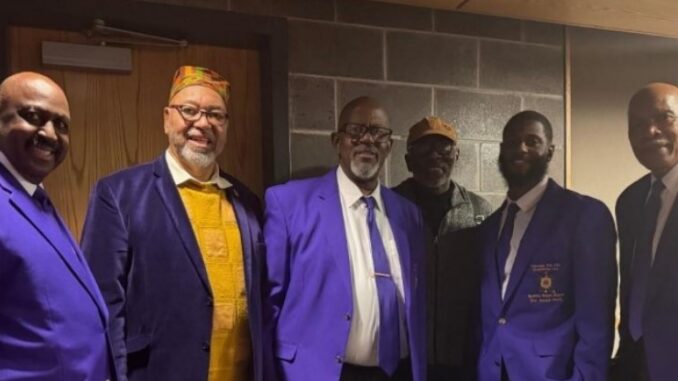
Inside the Bennie G. Thompson Academic and Civil Rights Research Center, generations gathered, students, elders, fraternity brothers, faculty, artists, and community leaders, for the annual Black History Program hosted by the Mighty Men of Epsilon Kappa Kappa Graduate Chapter and the Rho Epsilon Undergraduate Chapter of Omega Psi Phi Fraternity, Inc.
The event was more than ceremony. It was continuation.
Service Rooted in Madison and Hinds Counties
Epsilon Kappa Kappa (EKK), based in Canton, Mississippi, has long been a quiet force in Madison County. Through mentorship initiatives, scholarships, civic engagement, and partnerships with organizations such as Uplift Incorporated, EKK works to strengthen families, encourage youth achievement, and promote economic and educational advancement. Their work is not performative. It is present. It is local. It is consistent.
The undergraduate chapter, Rho Epsilon — known across the state as “PE” — carries its own historic distinction. Rho Epsilon is the first undergraduate chapter of Omega Psi Phi established Mississippi. For decades, it has shaped leaders on Tougaloo’s campus and beyond, embedding service and scholarship into the DNA of student life.
Together, the graduate and undergraduate brothers created a program that honored both legacy and momentum.
A Building with History
The setting itself mattered.
The program was held in the Bennie G. Thompson building, named for Mississippi’s longtime U.S. Congressman, a Tougaloo College graduate who has represented Mississippi’s Second Congressional District since 1993. Congressman Thompson, one of the longest-serving members of Mississippi’s congressional delegation and a leading voice on homeland security and civil rights, is a product of Tougaloo’s legacy of leadership and activism. His name on that building is not symbolic, it represents the college’s enduring connection to public service and justice.
Tougaloo, founded in 1869, has long been a cornerstone of Mississippi’s civil rights history. During the 1960s, it served as a safe haven and organizing hub for student activists, Freedom Riders, and national leaders of the Civil Rights Movement. On this Sunday, that history was not simply remembered, it was embodied.
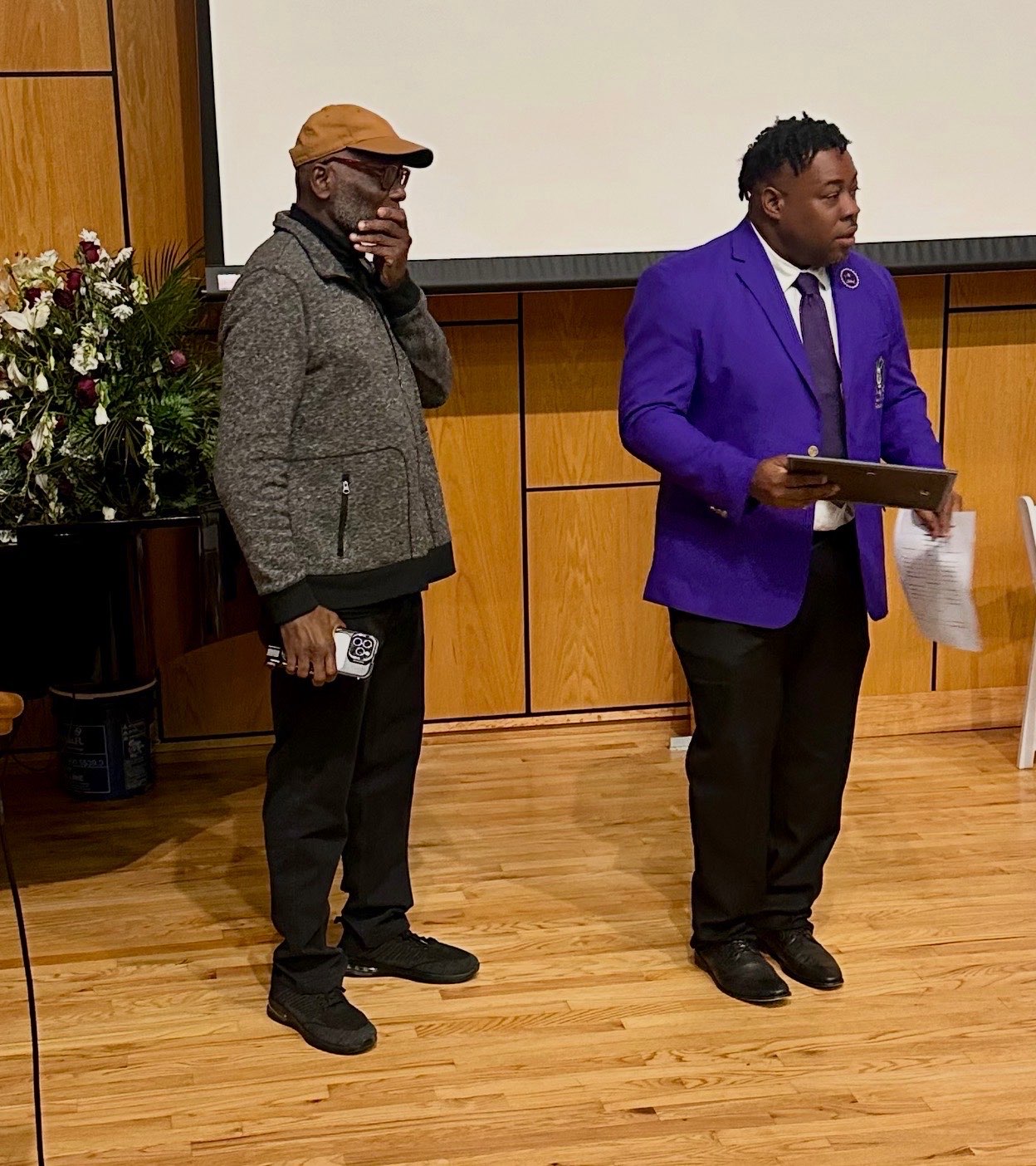
Rho Epsilon brothers Andrew Magee and Jay Holmes spoke briefly about Tougaloo’s role in the movement, reminding attendees that the campus lawns and lecture halls were once staging grounds for strategic resistance and intellectual revolution.
Why Brigadier General Charles Young Matters
This year’s Black History focus turned toward Brigadier General Charles Young, a name not always taught in classrooms, but one that should be.
The late Charles Young was the third Black graduate of West Point, a distinguished military leader, diplomat, and scholar. During World War I, despite his record of excellence, he was forced into retirement under controversial circumstances widely understood to be rooted in racial politics. Determined to prove his fitness for service, Young famously completed a grueling 500-mile horseback ride to Washington, D.C., in an effort to be reinstated.
His story has a Mississippi dimension.
Historical records indicate that political pressure from Southern leaders, including a U.S. senator from Mississippi, was part of the broader resistance to Young’s wartime advancement. Mississippi was not just geographically distant from that decision; it was politically connected to it.
Yet the Mississippi connection runs deeper still.
Young later served as a U.S. military attaché to Liberia. Liberia itself holds a significant historical tie to Mississippi. In the 19th century, formerly enslaved people from Mississippi were among those who migrated to Liberia through organized colonization efforts. One settlement was even known historically as “Mississippi in Africa,” located in what is now Sinoe County.
So, on this day, as Charles Young’s life was examined, the audience was asked to consider a powerful intersection: Mississippi’s political role in Young’s struggle, Mississippi’s diaspora link to Liberia, and Young’s diplomatic service in that same West African nation. History, once again, revealed itself as interconnected and global.
Enter Monty Ross
If the historical framing grounded the audience, the keynote speaker lifted it.
Monty Ross, producer, filmmaker, and one of the creative architects behind some of the most influential films in Black cinema, took the stage not as a distant icon, but as a storyteller among family.
Ross, a producer on early Spike Lee films including She’s Gotta Have It and Do the Right Thing, is a graduate of Morehouse College and a key figure in the generation of HBCU-trained creatives who reshaped American film in the late 20th century. He shared personal reflections about how he, Spike Lee, Samuel L. Jackson, Angela Bassett, and the late Bill Nunn were once simply students and friends at HBCUs like Morehouse, Clark Atlanta University, and Spelman College, unsure of their futures, but certain of their hunger.
What changed, Ross explained, was commitment.
“You don’t have to do everything,” he told the students. “You just have to know your space and master it.”
He spoke candidly about collaboration, about understanding your role on a team and respecting the collective vision. He urged students to find what they are most passionate about and focus on it relentlessly.
And then he pivoted.
Artificial Intelligence, Ross insisted, is not something to fear. It is something to learn.
“AI is a tool,” he said. “If you don’t learn it, somebody else will use it better than you.”
In a room filled with broadcast journalism students, aspiring filmmakers, musicians, and scholars, the message landed clearly: adapt, evolve, stay curious.
A Town Hall for the Future
The evening did not end with applause.
After the Black History Program concluded, Monty Ross was joined by two-time Grammy Award-winning music producer and member of Omega Psi Phi, Ron Carbo for a town hall discussion on Film, Music, and Artificial Intelligence.
Carbo, whose career includes producing and engineering Grammy-winning projects and working alongside major recording artists, brought a music industry lens to the conversation. With decades of experience in sound production, artist development, and global touring, Carbo reinforced the idea that excellence is built on discipline and technical mastery.
For two hours, Tougaloo students engaged the pair in close, candid dialogue. Broadcast journalism students asked direct questions about navigating media landscapes, protecting intellectual property, and maintaining authenticity in an algorithm-driven world.
There were no velvet ropes. No handlers. Just access.
Students left not only inspired, but connected with business cards exchanged, mentorship conversations started, and internships discussed.
More Than a Program
The annual Black History Program hosted by EKK and Rho Epsilon is open to the public. It often includes speakers from various fraternities and sororities, reinforcing unity across Black Greek-letter organizations. Its mission is straightforward yet expansive: educate the world about the accomplishments of Black Americans before the founding of this country, during its formation, and into its present and future.
The program delivered on that mission.
It honored a 19th-century military pioneer.
It acknowledged Mississippi’s complex role in national history.
It highlighted Liberia’s diasporic ties.
It celebrated Tougaloo’s civil rights legacy.
It bridged film, music, and emerging technology.
And perhaps most importantly, it demonstrated that Black History is not static.
It is not confined to February.
It is not confined to textbooks.
It is not confined to the past.
It is mentorship in real time.
It is students asking bold questions.
It is alumni returning to pour back into the next generation.
On that Sunday in February, in a building named for a Tougaloo graduate who went on to shape national policy, surrounded by young leaders from the first undergraduate chapter of Omega Psi Phi in Mississippi, history did what it does best when we allow it:
It connected yesterday to tomorrow.
And it reminded us that the story is still being written.
Be the first to comment